

“Politics is the gentle art of getting votes from the poor and campaign funds from the rich, by promising to protect each from the other.” Oscar Ameringer
Bankruptcy is a political creature in its origin. The right to create bankruptcy laws is written in the United States Constitution. Congress over time has made use of this right, and enacted bankruptcy laws known as statutes that govern bankruptcy rules and procedures. The last big overhaul was in 2005, known as the Bankruptcy Abuse Prevention and Consumer Protection Act (BAPCPA). The banking and creditor industry lobbied for years to pass this legislation. And several years after its passage, most people are still looking for the “Consumer Protection” part of the statute.
Since bankruptcy laws are borne in our political sausage making machine, the laws’ creation and changes are dependent on the mood of the country, the strength of the lobbyists, who’s in Congress and who’s the president, among a myriad of other factors. For as long as I can recall, every year it seems it is declared that politics is getting worse. I don’t know if this actually true, or if it just feels like it.
But I do sense a lot of desperation and rage. The Tea Party coalesced around a message against a big government that helped create a massive debt problem. Occupy Wall Street seems to be gaining traction with a message about the majority feeling disenfranchised by an increasing wealth gap created and sustained in part by a corrupt corporate/capitalist relationship. Someone sent me this Venn diagram about the two movements:
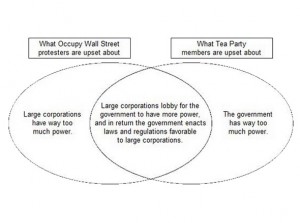
The point is that whatever the underlying belief is about the current cause of our problems as a nation, a lot of people are tired and angry. This feels like a recipe for change. Whether it’s a good recipe, that remains to be seen.
A lot of people need help. And bankruptcy is one way to help people in financial distress. My hope is that this turmoil creates the political will and landscape to rectify some of the mistakes in the bankruptcy code. Two examples:
- Debt Limits in Chapter 13. Congress set the maximum amount of debt that a person can have in Chapter 13; you can have $360,475 in unsecured debt, and $1,081,400 in secured debt. These limits apply across the nation. This makes no sense as a national number. Don’t you think the mortgages in the Bay Area might be a little different than Mississippi? If you have mortgages or liens that exceed this number, you’re looking at Chapter 7 or 11 only. A lot of people that should be in Chapter 13 are left out by this senseless restriction. The irony is that many of the changes brought by BAPCPA were intended to funnel more people from 7 into 13. Well done, Congress, well done.
- Student Loans. These are not usually dischargeable in any chapter of bankruptcy. Congress decided certain things were important and as a policy not dischargeable, such as child support and alimony. Okay, fine. But alimony and child support were given a special status. In Chapter 13 creditors are assigned priorities on how they are repaid. For example, child support arrears are a high priority debt, and your typical credit cards are low priority. This means that if you file a Chapter 13 and repay some of your debt, the money would first go to the child support arrears before the credit cards ever see a dime, if they see any money at all. Congress decided child support is both nondischargeable, and should be given a higher priority so that it is paid off.
Student loans are also nondischargeable, but were not given an explicit high priority status. They are treated like a last in line creditor. This means that at the end of a Chapter 13, depending on the arrangement of your debts, you may actually owe more to your student than when you started because they never received any of the money as a low priority creditor, so interest and penalties continued to accrue. This is one of the worst rules I keep running into. It only gets worse as student loan debts have swelled to record highs.
Is the current national mood willing and able to foster changes to the bankruptcy code? I hope so. I don’t believe in writing a bankruptcy code that is so loose that people “get away” with misdeeds through bankruptcy. But I also believe in fairness and correcting poorly or unfairly drafted legislation. The current code is riddled with errors that need legislative attention, particularly now as more and more of our clients hang on the downward sliding precipice of middle class status.
Images courtesy of James Sinclair and Schteeve2010.