Tag Archives: chapter 7 bankruptcy

Free Workshop for Dealing With Your Debts

Free Workshop at the San Francisco Law Library on February 6, 2012.

San Francisco Bankruptcy Lawyers Jeena Cho and Jeff Curl will address various ways to deal with your debt including:

  • Debt settlement
  • Chapter 7 or Chapter 13
  • Dealing with underwater homes
  • Consequences of doing nothing
Monday, February 6, 2012
12:00 PM - 1:00 PM

San Francisco Law Library
401 Van Ness Ave, Room 400
San Francisco, CA 94102

Bankruptcy Alphabet: C is for Cars

Will I lose my car if I file for bankruptcy?

This is probably one of the most common question and concerns I address for clients contemplating bankruptcy. (I’ll also add Harley’s but that should go into its own separate category.) So, what happens to a car in bankruptcy? The answer to this seemly simple question is “it depends.” (I know. We lawyers give this answer a lot.)

Is there equity?

The first thing we need to look at is if there is any equity in the car. Obviously, if the car is owned outright, without any loans, it has equity. In this situation, whether you can keep the vehicle or not depends on what other assets you have.

Let’s assume your vehicle is worth $10,000. Assuming you don’t have a home with equity, we are going to use the 703 exemption. First, we use the vehicle exemption to protect the first $3,300. Then the remaining $6,700 would have to come from the “wild card.”

What if you have too much value in other assets to be able to protect your vehicle? In this situation, we would file a Chapter 13 to protect the vehicle. The other alternatives are to work out some sort of a buy back deal with the Chapter 7 trustee or allow the trustee to sell the vehicle and give you cash for the amount you were able to exempt.

The next situation is where you have a vehicle but there is a loan securing the vehicle. In this situation, we also look to see if there is equity. For example, if your vehicle is worth $13,000 but there is a car loan against it for $10,000, you have $3,000 in equity.

Just like in the example above, we need to use an exemption to protect the $3,000 in equity. Oftentimes, the loan balance is greater than the vehicle value, so there is no equity to protect.

In such situations, the next thing we look at is if you are current on your loan payment. Frequently, you can keep your vehicle after Chapter 7 bankruptcy by staying current your loan - before, during and after bankruptcy.

Protecting your car through Chapter 13

Chapter 13 has additional tools which allows you to keep your vehicle. If you have too much equity in the car, you can repay the unexempt value over a 3-5 years and keep the car. For example, if we can protect everything but $3,000 in equity, that would be approximately $50/month ($3,000/60 months*)

*This is an oversimplified calculations. There are other factors that go into the calculation such as liquidation value and trustee commission.

Additional benefits in Chapter 13

In Chapter 13, there are three additional benefits that doesn’t exist in bankruptcy.

1. Reduction in interest rate. If you have a high interest loan, we can reduce it down to about 5%. Obviously, this can lead to significant savings.

2. Lengthen the repayment term. Chapter 13 allows you to stretch the repayment term to 60 months, hence reducing the monthly repayment amount.

3. Cram down. If you have a vehicle that is worth less than the loan balance, we may be able to “cram down” the loan, provided the loan is more than 910 days old.


Other C’s from Bankruptcy Attorneys

Chapter of Relief
Collection Agencies
Competence and Compassion
Conversion
Cosigner
Counseling
Cramdown
Cramdown
Credit counseling
Credit counseling
Creditor
Creditor
Creditors Meeting

Image credit: Leo Reynolds

Can you keep a car when you file for bankruptcy?

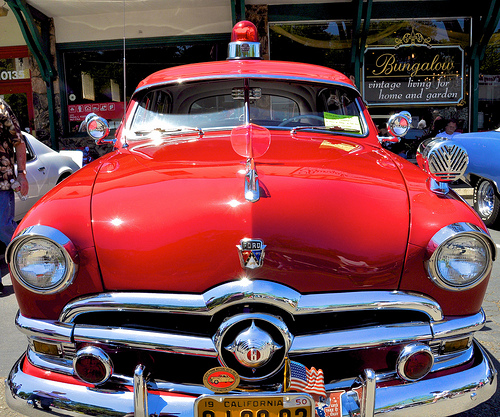
Fire Chief's car

By: Jeena Cho

Recently, I received a call from a local TV station asking me if a person can keep a car if he or she declares bankruptcy. I get asked similar questions all the time and I cringe slightly because this seemingly simple question doesn’t have a simple answer. The person from the TV station said they are just looking for a simple, short answer for their viewer call-in segment. So, I gave the shortest answer I could, which was “generally, yes, but please consult with a lawyer.”

Since this is our blog and I’m not restricted to a 10 second sound bite, I’ll give a longer answer to this not necessarily simple question.

When you declare bankruptcy, you are entitled to keep a certain amount of property under the exemption laws of your state. Luckily, California has one of the most generous exemptions of any state, so in the majority of cases you can keep all of your property. Of course, the problem is that you don’t want to be the small percentage of people that has more than what the exemption law allows and risk the trustee taking your property.

In California, there are two sets of exemption laws for protecting and keeping your property. For purposes of this discussion, we’ll use one set of exemptions. Under this set of exemptions, there is a vehicle exemption of $3,525. I often have clients tell me s/he heard from someone (not a good source of information) that everyone gets to keep one car. Not true. The law says you can have a vehicle with equity up to $3,525. So, for example, if you have a Honda Civic worth $15,000 but there is a loan against it for $12,000, you can keep the vehicle since it only has $3,000 in equity.

So, what happens if you have more than $3,525 in equity? We then look to the “wildcard” exemption. Wildcard allows you to protect property up to $23,250 that would otherwise be unprotected. Generally, it’s used to protect cash, money in bank account, and other property that doesn’t have other specific exemptions.

This is where it gets tricky because let’s assume you have the Honda Civic but you own it outright. That would mean we would have to dip into the Wildcard exemption and use $11,475 towards the car ($15,000 - $3,525 = $11,475), leaving you only $11,775 to protect your other assets.

And there are other considerations such as what Chapter of bankruptcy you file. If you file Chapter 7 bankruptcy and are behind on payments at the time of filing, you risk losing the car. On the other hand, in Chapter 13, if you are behind on payments, you may be able to save the car.

Another consideration is the lender on your car, particularly in Chapter 7. Some lender have particular rules called “reaffirmation” for keeping cars.

As you can see, this seemingly innocuous question doesn’t have a simple answer. And getting the wrong answer may mean losing assets in bankruptcy. Google or your friends are not substitutes for good legal advice.

What’s the Difference between Chapter 7 and Chapter 13 Bankruptcy?

Written by San Francisco bankruptcy attorney, Jeena Cho

While bankruptcy is complicated, let’s break it down and look at the basics in order to form an understanding of the two most common forms of bankruptcy for individuals: Chapter 7 and Chapter 13.

A Chapter 7 bankruptcy is the more common of the two. There are two important analysis in Chapter 7.

1. Income

2. Assets

First, the income. If your income exceeds the state median, you must pass the “Means Test.”

Second, you run the risk of having your assets liquidated if it’s not exempt. Luckily, California has fairly generous exemptions, and in most cases, you can protect all of your assets.

In general, Chapter 7 is most appropriate for people who can pass the Means Test, and has no unexempt assets. Chapter 7 takes about 4 months from the date of filing until discharge (when your debts are forgiven).

A Chapter 13 bankruptcy, is a repayment plan allowing you to repay some or all of your debt for 3-5 years.

Let’s get two things straight here.

1. Amount of debt repaid is determined by greater of your “disposable income” or “liquidation value” of your unexempt property. Note that amount repaid is not determined by the amount of debt you have.

2. It is rare that you will be required to repay 100% of your debt! Chapter 13 is not a debt consolidation plan like Consumer Counseling.

Which bankruptcy is right for you? That’s a tough question, and one best discussed with a qualified San Francisco bankruptcy attorney.

HOW DO I KNOW IF I SHOULD CONSIDER BANKRUPTCY: 10 WARNING SIGNS

Written by San Mateo bankruptcy attorney, Jeff Curl

Here are ten warning signs that perhaps you should consider speaking with a professional about your financial situation.

  1. You have begun to use credit cards to pay for basic necessities such as: groceries, gasoline, heat, medication, electricity, rent, etc.
  2. You are making minimum monthly payments on your credit card(s) without any hopes of being debt free.
  3. You continue to transfer your balances from one credit card to another (or are taking cash advances).
  4. You have been denied additional credit.
  5. You are unable to increase your income, e.g., you have lost your job and can’t find another one, or you have a job but it doesn’t pay you enough to allow you to pay your bills.
  6. You are consistently paying your bills late (because the money is not there, not because you are disorganized or forgetful).
  7. You are being sued on unpaid debt, or your wage is being garnished.
  8. Your home is about to be foreclosed on.
  9. Debt collectors are harassing you.
  10. Your debt is causing you stress that is affecting your health and quality of life.

If one or more of the above applies to you, it might be time to talk to a San Mateo bankruptcy attorney. Life doesn’t have to be like this, and bankruptcy offers you immediate change.