

Tag Archives: credit card debt

Ripping off the debt Band-Aid

By: Jeena Cho

I often meet with people who spend months or years peeling the debt Band-Aid off millimeters at a time instead of yanking it off at once. Instead of making concrete plans to either repay the debt, settle, or file for bankruptcy, they go on extending the pain and the inevitable.

Here’s the problem with credit card debt. It enables you to live beyond your means. Repaying the debt requires 1. stop using your credit card and 2. scale back your spending to create disposable income. The difficulty is that in order to repay $1 borrowed requires you to earn approximately $2 to pay taxes and all the associated costs of earning the money (e.g., transportation, clothing, day care, lunches, etc.) Therefore, you not only have the feeling of being deprived when you stop charging expenses on the card, but having to live with a lot less money when you start to repay it.

Here’s an example.

John has $30,000 in credit card debt at 18% interest. Assuming his monthly minimum payment is interest + 1% of the balance, his payment would be $750. Assuming he doesn’t make any additional purchases, his monthly repayment amount would decrease slightly as follows.

Mo Min P/ment Interest Principal Remaining Balance

1 $750.00 $450.00 $300.00 $29700.00

2 $742.50 $445.50 $297.00 $29403.50

3 $735.09 $441.05 $294.04 $29109.91

4 $727.75 $436.65 $291.10 $28819.25

5 $720.48 $432.29 $288.19 $28531.52

6 $713.29 $427.97 $285.32 $28245.71

7 $706.15 $423.69 $282.46 $27962.85

8 $699.07 $419.44 $279.63 $27682.93

9 $692.07 $415.24 $276.83 $27405.93

10 $685.15 $411.09 $274.06 $27131.85

11 $678.30 $406.98 $271.32 $26860.70

12 $671.52 $402.91 $268.61 $26592.48

Here is the danger. By making the minimum payments, it would take you 451 months or 37.5 years to repay this debt in full. You’d also end up paying $44,416.16 in interest! Also, since the monthly minimum payments decrease, the temptation is there to charge more on the cards.

Now, let’s suppose you made a plan to repay all of your debt in 5 years. Your repayment amount isn’t that much different than the minimum payment amount at $761.80 per month for 60 payments. So, instead of taking almost 38 years to repay the debt, you can be done in 5 years.

Some expenses you may consider cutting or decreasing includes:

  1. Cable, or other monthly/annual subscriptions
  2. Dining out - lunch and dinner
  3. Grocery bills - find cheaper food
  4. Pet expenses
  5. Clothing, shoes, purses, jewelry, etc.
  6. Storage units
  7. Travel expenses

The important thing to realize is that for many people in overwhelming debt, no amount of tightening the belt, and trimming all the expenses will free up enough money to repay the debt within a reasonable amount of time. If you fall into this camp, it’s best to realize this sooner rather than later. What’s the point of paying $750 per month for years in minimum payments since it does almost nothing to reduce the principal balance?

There are few things that frustrate me more than meeting someone who has spent so much time trying to avoid the big “ouch” of ripping off the debt Band-Aid quickly that they suffer so much more in the long term. So, my message is this. If you are determined to avoid bankruptcy, make a concrete plan to repay your debt as soon as you possibly can. This will save you tens of thousands in interest alone. Also, know your own situation enough to know that repaying is simply not an option.

In other words, leave the band-aid on and heal, or just rip it off. Stop torturing yourself.
Should you file?

By: Jeena Cho

If you have overwhelming debt and are considering bankruptcy, here are some tell-tell signs you should consider filing (or at least pick-up the phone to get help).

  1. Borrowing from Peter to pay Paul. If you’ve been playing musical chairs with your credit cards, borrowing from Chase to pay Discover, it’s definitely time to speak with a professional about your finances.
  2. Paying the monthly minimum on your credit card. This may be one of the most worst mistakes clients make. By making the minimum payment, you are basically repaying interest only. The average credit card loan will take 33 years to repay if you pay the minimum amount. That’s a really long time!
  3. Insufficient disposable income. Disposable income is the money you have left over at the end of the month after paying all of your bills. If you are in the red every month because you have too much debt, it’s time to get help. Another good indicator is if you’re charging groceries because you don’t have enough money to buy milk.
  4. Your wages are being garnished or you have pending lawsuits. This should be fairly obvious. If you have creditors knocking on your door - time to get help.
  5. You can’t sleep or you are worried about debt. Frequently, I’ll meet with clients that have not slept for months, have been fighting with their spouse or just plain “stressed out” because of debt.

Don’t make the mistake we see most often - waiting too long.

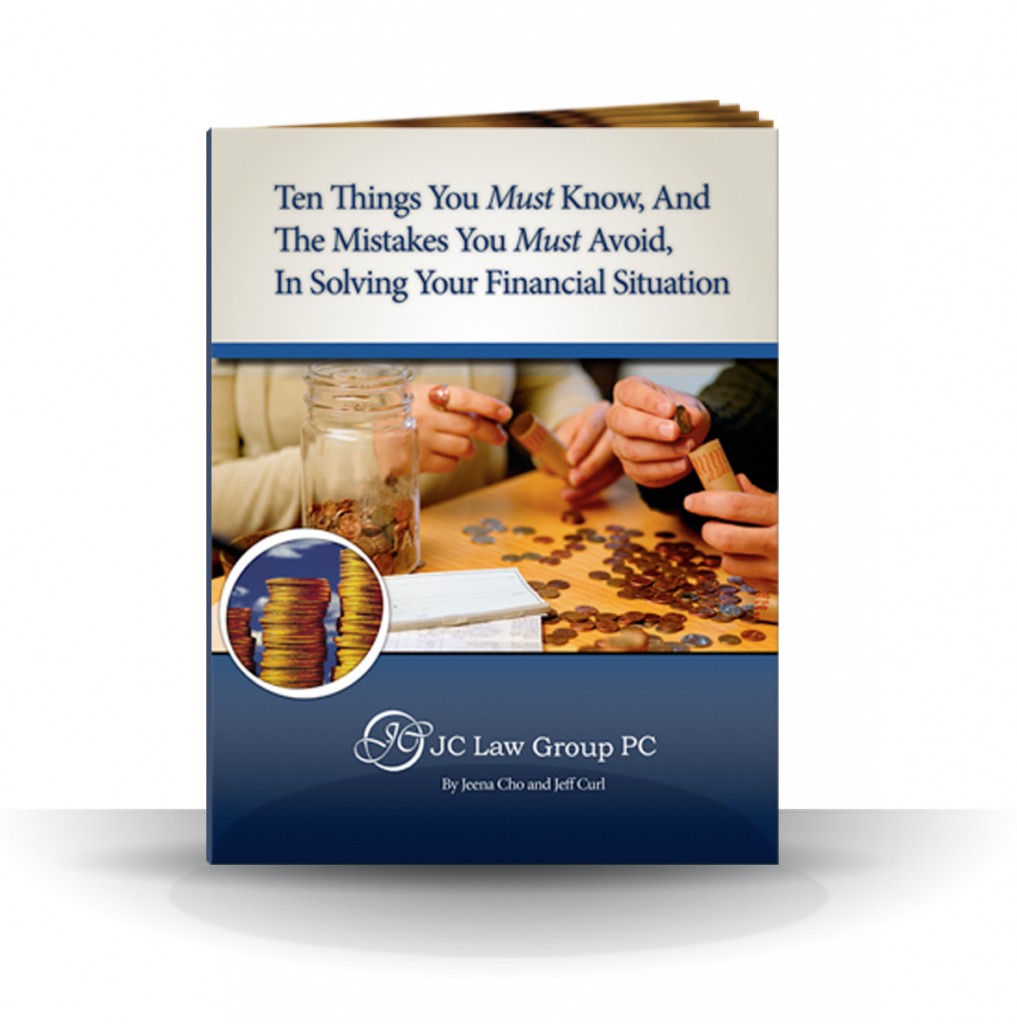
Ten Things You Must Know, And The Mistakes You Must Avoid, In Solving Your Financial Situation

By: Jeena Cho & Jeff Curl

Are you contemplating bankruptcy? Do you have questions? Download our free guide.

Topics Covered:

1. You are not alone.
2. Consequence of inaction (what if I do nothing?)
3. You may qualify for Chapter 7
4. Can you keep your property in Chapter 7?
5. Chapter 13 vs. debt consolidation
6. Who will find out about your bankruptcy?
7. Can I afford bankruptcy?
8. Truth about credit counseling
9. Getting new credit after bankruptcy
10. What’s your “exit strategy?”

Click to download.

Need help but afraid to ask?

By: Jeena Cho

As a society, there are two things we don’t talk about. Death & Debt. Frequently, when people are experiencing financial distress, they go into denial mode. Instead of assessing their situation and tacking the problem, they deny thinking something will change. Of course, debt problems do not get better without proactive action. It gets worse. Interest rates continue to rise, you borrow from Peter to pay Paul.

If you are experiencing financial trouble, you should seek help. Go see a financial advisor, reach out and ask a friend or a family member. You will soon find that you are not alone in your problems.

For those of you that do not see any hope of being able to reduce your debt, we are offering a free seminar. If you do not want to attend in person, you can attend on the Web. It’s totally confidential. We’ll discuss the different options to deal with your debt including debt settlement and bankruptcy.

Our goal is to educate you with the options available. One of the most frequent comment I get at the end of a consultation is “I feel so much better” or “I should have come in a long time ago.” We hope to do the same through these workshops.

For more information or to register, go to http://www.jclawgroup.com/workshop/

Do-It-Yourself Guide to Debt Settlement

By: Jeena Cho

Be Aware of Debt Settlement Companies

Debt settlement companies are running their ads everywhere - “Settle your debts for pennies on the dollar.” “Government sponsored debt settlement plan.” “We have special programs with the credit card companies to settle your debt.” The truth of the matter is that there is nothing that a debt settlement company will be able to do for you that you probably could not do yourself. Just in the last month, I met with at least 6 clients who has been scammed by these so-called debt settlement companies.

Here’s a run-down on how debt settlement companies work:

  1. Instead of paying your credit card, you make monthly payments to the debt settlement company. (Generally, a fixed amount.) You will be required to stop paying your credit cards.
  2. The debt settlement company almost always receive their fees upfront. In another words, not a single dollar may be going towards actually settling your debts for months.
  3. After you have accrued sufficient funds, the debt settlement companies will offer to settle your debt with your creditor.

Here’s what the debt settlement companies won’t tell you:

  1. Credit card companies are under no obligation, what-so-ever to accept any offers. There is no special government backed program. They do not have “special” relationships with the credit card companies.
  2. Frequently, especially with Chase and Bank of America, they will simply choose to sue you.
  3. If you are sued, the debt settlement companies will not defend you. To litigate a civil case can cost tens of thousands of dollars. The debt settlement company is not going to pay your attorney fees.
  4. 1099-C. If the debt settlement company is successful in negotiating the debt, the amount forgiven may be taxable to you. (For example, if you had $100,000 in credit card debt and it’s settled for $50,000, you will owe taxes on the $50,000 that is forgiven. If you are in the 15% tax bracket, that will mean you will owe Uncle Sam $7,500.)
  5. Many debt settlement companies are scams. That’s right. For more information, go to the FTC website.

If you have money to be able to settle your debt, you can try the following.

  1. Contact the lender directly. Unfortunately, most credit cards won’t deal with you until you’ve been behind on your payment. Non-payment will mean your credit score will suffer.
  2. Considering offers. In general, once you fall behind on your payments, credit card companies will send you settlement offers. (They may also sell or transfer the debt to a third party collection agency.) The more you can offer in one lump sum, the better the deals will be.
  3. Ask for it in writing. Any offers should be verified in writing. Ask the creditor to send you in writing the offer you will sign.
  4. Paying the settlement. NEVER EVER send the settlement check out of your personal checking account. Why? Because, you do not want them to have your checking account number, which they can use to draw money out of if they are successful in winning a lawsuit against you. You should always send the settlement money in money order or cashier’s check.

Word of caution. In order to settle your debt, you need cash. I frequently meet with clients who does not have any disposable cash that insist on settling their debts. Before you spent what little cash reserve you have, or liquidate your assets, sit down and plan out an exit strategy. Ask yourself, “how much debt do I have?” and “how much can I possibly save to get out of debt?”

Disclaimer: The information contained in this article is informational in nature and is not a substitute for legal advice. Consult with an attorney for advice on your particular circumstances.