

Tag Archives: Debt Settlement
Should I borrow from family and friends to pay off my credit card?
By: Jeena Cho
Q: I’ve had my hours reduced at work and no longer working overtime. To make ends meet, I’ve been using my credit cards. I have about $30,000 in credit card debt, paying very high interest rate (hovering around 30%). I have five cards. My parents offered to loan me $15,000 from their savings. Can you help me settle my debt? I don’t want to file for bankruptcy.
I get questions like this all the time. Clients wanting to borrow money from family and friends to pay off or settle credit card debts. Usually, the question is prefaced by “I read on Google…” or “My friend told me…” I cringe every time someone says this because I’ve met too many clients who has tried this strategy, failed and comes in to file for bankruptcy anyway. Now, in addition to listing Chase, Discover, American Express, etc. on his or her bankruptcy petition, the client has to add the family member or friend on the petition too.
To make matters worse, if you’ve repaid your family or friend before filing the bankruptcy, he or she may be considered an “insider.” This means that the Trustee in your case can potentially demand the money back from your family or friend! That sure makes for an uncomfortable conversation at the dinner table.
The reason why debt settlements generally don’t work is because it’s difficult (if not impossible) to get all of your credit cards to play ball. You might be able to settle 4 cards, but what if the last card holds out? Or decides to sue you instead? How about taxes? Do you have enough money set aside for taxes on the forgiveness of debt? (That’s right. Whatever the credit cards forgive, will be attributed as income to you.) Don’t make the mistake of throwing your family or friend’s good money after your bad credit card debt.
Debt settlement can work in some cases where the client has 1 or 2 creditors and has lump sum cash to settle. For more information on debt settlement, read our Guide to Living Debt-Free/ Bankruptcy and Other Alternatives.
Have you tried debt settlement? Did it work out for you? Please share your story.
Image Credit: futurowoman
Ten Things You Must Know, And The Mistakes You Must Avoid, In Solving Your Financial Situation
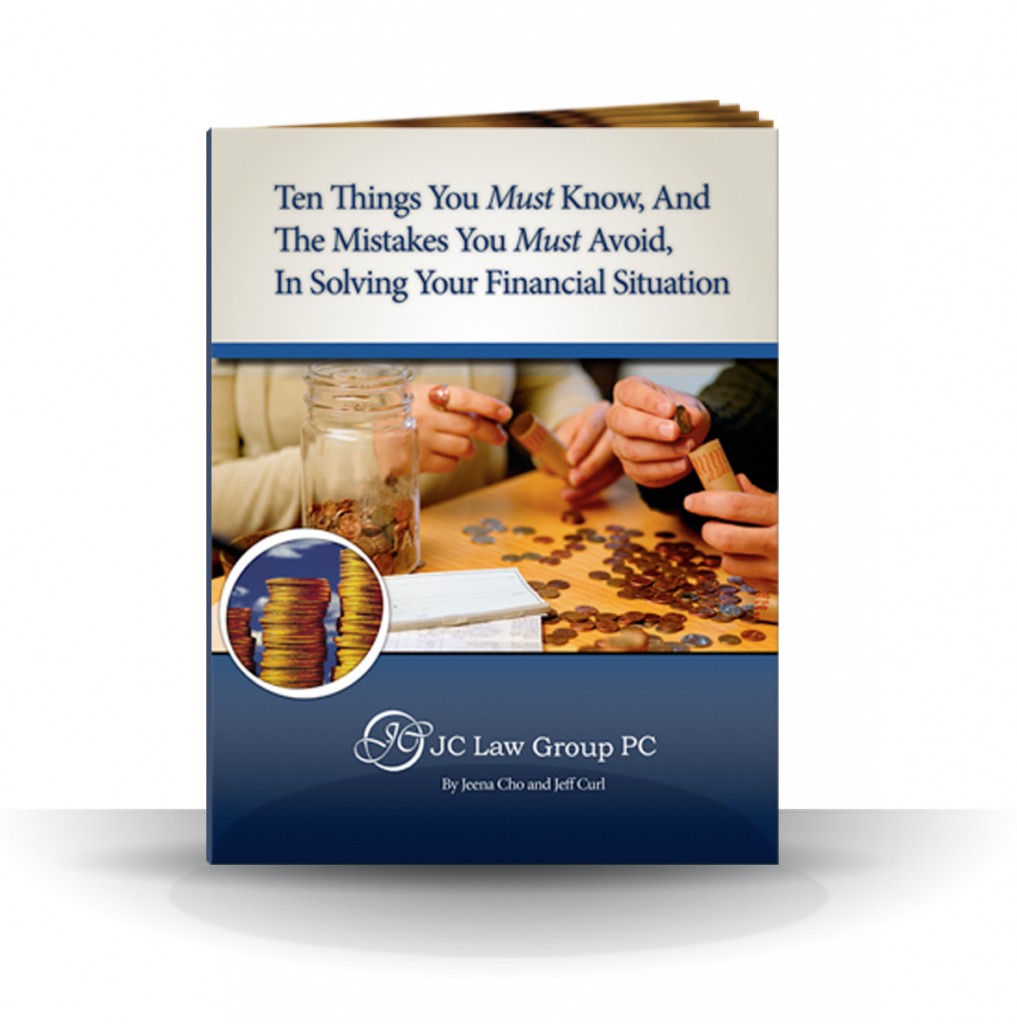
Are you contemplating bankruptcy? Do you have questions? Download our free guide.
Topics Covered:
1. You are not alone.
2. Consequence of inaction (what if I do nothing?)
3. You may qualify for Chapter 7
4. Can you keep your property in Chapter 7?
5. Chapter 13 vs. debt consolidation
6. Who will find out about your bankruptcy?
7. Can I afford bankruptcy?
8. Truth about credit counseling
9. Getting new credit after bankruptcy
10. What’s your “exit strategy?”
Need help but afraid to ask?
By: Jeena Cho
As a society, there are two things we don’t talk about. Death & Debt. Frequently, when people are experiencing financial distress, they go into denial mode. Instead of assessing their situation and tacking the problem, they deny thinking something will change. Of course, debt problems do not get better without proactive action. It gets worse. Interest rates continue to rise, you borrow from Peter to pay Paul.
If you are experiencing financial trouble, you should seek help. Go see a financial advisor, reach out and ask a friend or a family member. You will soon find that you are not alone in your problems.
For those of you that do not see any hope of being able to reduce your debt, we are offering a free seminar. If you do not want to attend in person, you can attend on the Web. It’s totally confidential. We’ll discuss the different options to deal with your debt including debt settlement and bankruptcy.
Our goal is to educate you with the options available. One of the most frequent comment I get at the end of a consultation is “I feel so much better” or “I should have come in a long time ago.” We hope to do the same through these workshops.
For more information or to register, go to http://www.jclawgroup.com/workshop/
Do-It-Yourself Guide to Debt Settlement
By: Jeena Cho
Be Aware of Debt Settlement Companies
Debt settlement companies are running their ads everywhere - “Settle your debts for pennies on the dollar.” “Government sponsored debt settlement plan.” “We have special programs with the credit card companies to settle your debt.” The truth of the matter is that there is nothing that a debt settlement company will be able to do for you that you probably could not do yourself. Just in the last month, I met with at least 6 clients who has been scammed by these so-called debt settlement companies.
Here’s a run-down on how debt settlement companies work:
- Instead of paying your credit card, you make monthly payments to the debt settlement company. (Generally, a fixed amount.) You will be required to stop paying your credit cards.
- The debt settlement company almost always receive their fees upfront. In another words, not a single dollar may be going towards actually settling your debts for months.
- After you have accrued sufficient funds, the debt settlement companies will offer to settle your debt with your creditor.
Here’s what the debt settlement companies won’t tell you:
- Credit card companies are under no obligation, what-so-ever to accept any offers. There is no special government backed program. They do not have “special” relationships with the credit card companies.
- Frequently, especially with Chase and Bank of America, they will simply choose to sue you.
- If you are sued, the debt settlement companies will not defend you. To litigate a civil case can cost tens of thousands of dollars. The debt settlement company is not going to pay your attorney fees.
- 1099-C. If the debt settlement company is successful in negotiating the debt, the amount forgiven may be taxable to you. (For example, if you had $100,000 in credit card debt and it’s settled for $50,000, you will owe taxes on the $50,000 that is forgiven. If you are in the 15% tax bracket, that will mean you will owe Uncle Sam $7,500.)
- Many debt settlement companies are scams. That’s right. For more information, go to the FTC website.
If you have money to be able to settle your debt, you can try the following.
- Contact the lender directly. Unfortunately, most credit cards won’t deal with you until you’ve been behind on your payment. Non-payment will mean your credit score will suffer.
- Considering offers. In general, once you fall behind on your payments, credit card companies will send you settlement offers. (They may also sell or transfer the debt to a third party collection agency.) The more you can offer in one lump sum, the better the deals will be.
- Ask for it in writing. Any offers should be verified in writing. Ask the creditor to send you in writing the offer you will sign.
- Paying the settlement. NEVER EVER send the settlement check out of your personal checking account. Why? Because, you do not want them to have your checking account number, which they can use to draw money out of if they are successful in winning a lawsuit against you. You should always send the settlement money in money order or cashier’s check.
Word of caution. In order to settle your debt, you need cash. I frequently meet with clients who does not have any disposable cash that insist on settling their debts. Before you spent what little cash reserve you have, or liquidate your assets, sit down and plan out an exit strategy. Ask yourself, “how much debt do I have?” and “how much can I possibly save to get out of debt?”
Disclaimer: The information contained in this article is informational in nature and is not a substitute for legal advice. Consult with an attorney for advice on your particular circumstances.