

Category Archives: Business Bankruptcy

Bankruptcy Alphabet - S is Sole Proprietorship

by Jeff Curl

What happens to my sole proprietorship in bankruptcy?

Operating a sole proprietorship is a huge topic in bankruptcy that covers a lot of ground. So let’s take a couple of smaller bites and break down what operating a sole proprietorship means in bankruptcy. We have the pleasure of working with a lot of business owners, and sole props have their own special issues.


You Cannot “Just File for the Business”

A lot of sole prop owners in financial distress ask if they can file the business only, and not involve themselves personally. The short answer is no. Having a license from the city to operate as a DBA (doing business as) does not create a separate legal entity. Corporations and LLCs are formed as separate entities under the laws of the state where they are formed. Sole proprietorships do not obtain this legal designation. So if you are John Smith DBA John’s Auto Shop, you will be filing yourself and business as one.


Filing a Sole Prop in Chapter 7

It is really important to understand what happens when filing Chapter 7 and you are operating a business as a sole prop. Here are couple of major considerations:

  • When you file Chapter 7, all of your assets go into the bankruptcy estate, including the inventory and receivables of the business. Your Chapter 7 trustee is the trustee of the estate, meaning she or he controls the assets. Understanding the values of your assets is paramount because you are allowed to exempt and keep a certain amount, but it is not unlimited. If you cannot protect everything, the trustee may liquidate your unprotected assets.
  • The trustee is also responsible for any liabilities that arises from the business. Therefore, there’s a risk that the trustee may demand that you cease operating your business while the trustee administers your assets. This varies by trustee to trustee and varies by the business. For example, operating a restaurant as a sole prop has many inherent liability potentials, such as payroll taxes, suits by employees against the business owner, and injuries claimed by patrons. Contrast this with the person working as a consultant with his or her laptop out of their home that raises less concerns from a liability perspective. This is a factually sensitive discussion you should have with your bankruptcy attorney.

Filing a Sole Prop in Chapter 13

There are several distinction between Chapter 7 and Chapter 13 when it comes to operating a proprietorship. Here’s a couple of important ones:

  • The sole proprietor can continue to operate the business in Chapter 13 without the threat of shutdown by the trustee as can happen in Chapter 7. A sole proprietor can also opt to shut down the business before or during a Chapter 13 as well.
  • A Chapter 13 trustee does not liquidate assets like a Chapter 7 trustee.

In other words, Chapter 13 generally offers flexibilities and forgiveness that are not available in Chapter 7. But sometimes one chapter is better than the other, or sometimes you only qualify for one. Operating a business leads to a lot of complicated issues quickly in the bankruptcy world, so please consult with a bankruptcy attorney familiar with these complications.

Photo by elycefeliz
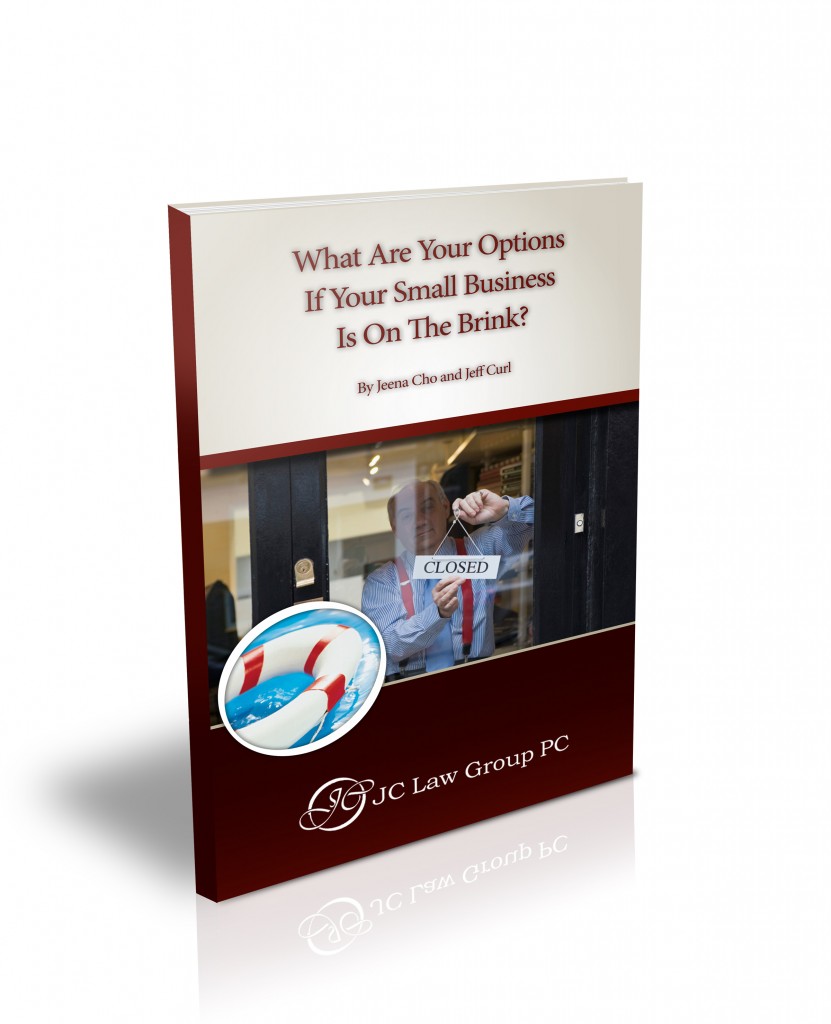
Bankruptcy May Help Save Your Small Business

By: Jeena Cho

Living in the Bay Area, I have many clients who are business owners. Oftentimes, these small businesses are heavily in debt and have little or no hope of survival unless it can shed its debts. What most small business owners do not realize is that bankruptcy may actually be a beginning rather then an end.

Let’s take two simple examples.

Example #1. You operate a business as a sole proprietorship. There is $20,000 of business assets and $150,000 of debts related to the business. In addition, the you have $50,000 of personal credit card debt.

Assuming the owner does not have significant amount of personal assets or other non-exempt assets, s/he can qualify for Chapter 7 bankruptcy regardless of his or her income. The business owner would qualify for Chapter 7 as a non-consumer case. The rule is that if more than 51% of your total debt was obtained for a non-consumer purpose (e.g., business purpose), you are not subject to the means test. This is particularly useful for those business owners who either has another high paying job or has a spouse with a high paying job.

As for the business assets, we would exempt those assets, hence being able to continue operation of the business after bankruptcy. Sometimes, it may be advantageous to incorporate the business as well.

Example #2. Let’s assume the same facts as above but that the business has a liquidation value of $60,000. In this situation, Chapter 13 may be an appropriate solution. In a Chapter 13, you would repay some of the debt. One of the common misconception about Chapter 13 is that you would have to repay all of your debt. Not true. The amount of your Chapter 13 is determined by the greater of the “liquidation analysis” or “disposable income.”

Liquidation analysis would be the portion of your assets that we could not exempt. In Example #2, the business owner would have to repay the unexempt portion of his business assets. The Wild Card exemption in California is approximately $23,000. Hence, leaving $37,000 of his business assets unprotected. That’s the amount which would have to be repaid in a Chapter 13 ($37,000/60 = $617/mo). (This is a very simplistic explanation because certain deductions are also made such as hypothetical trustee commission, cost of sale, taxes, etc.)

Disposable income test is a long calculation based on the Means Test where we take your gross income and make certain adjustments (e.g., taxes, medical expenses, health insurance, term life insurance, mortgage payments, etc.) At the end of the equation, whatever amount is left over would be paid to the Trustee for either 3 or 5 years.

In either Chapter 7 or a Chapter 13, at the conclusion of the case most of the debts (including credit card debts, SBA loans, and other business related debts) would be discharged, leaving you and the business free to continue to operate the business.

In the next article, I will address special consideration for businesses that are incorporated.

If you have a struggling small business, please call us for a consultation at (415) 963-4004.

Disclaimer: Unfortunately, it is impossible to give legal advice over the internet, no matter how well researched or written. Before relying on any information I give, contact a lawyer to discuss your particular situation. I am a San Francisco bankruptcy attorney. The information given is based on California law.


Google+

Can I Discharge my SBA Loan?

Can I discharge my SBA loan
By Jeff Curl

“Can I discharge my SBA loan?” I get asked this question a lot from small business owners exploring bankruptcy. The short answer is “yes.”

But you must be aware of the terms of the loan. The Small Business Administration (SBA) typically does not give a loan without obtaining some type of personal guarantee in exchange. At the very least, this means that the loan – and the liability for that loan – extends beyond the business to you personally. If you own property at the time of the loan, it is common for the SBA to require as a term of lending the money, that you permit the SBA to take an interest in your property such as placing a lien on your home.

This goes to the heart of whether it is the business and/or the person behind the business that files bankruptcy. When a small business owner operates as a corporation or LLC, he or she often believes that the liability all rests with the business. The personal guarantees and liens of the SBA loan, however, make the business owner personally liable.

This naturally leads to the question of whether the business can continue to operate, should dissolve or should file bankruptcy depends on several factors. This includes the type of business entity, future viability of the business, chapter of bankruptcy, assets and debts. That is just the beginning; no one can create an exhaustive list of every factor to consider because it depends on all the facts surrounding your circumstances. And many of these factors apply to whether a personal should file personally. The amount of an SBA loan itself can often be the determinative factor of whether to file.

So, yes, a loan from the SBA is dischargeable in bankruptcy. Work with your attorney to understand how far the SBA loan extends to you personally, and what you and your business need to do to protect your assets and discharge your debts.

What to Do With a Failing Small Business

Failing Small Business

This is a guest post by San Francisco Business Attorney, Trevor Caudle. This post addresses ways to dealing with a failing small business and the personal responsibility of the small business owner. Trevor also addresses the risk of piercing the corporate veil.

Perhaps the single greatest motivating factor in an individual’s decision to form a corporation or limited liability company is - you guessed it - to limit their personal liability. Well, what does this really mean? When we talking about “limited liability”, we literally mean taking the financial responsibility for casualties and debts and removing it from the shoulders of individual human owners and placing that responsibility at the feet of a legal entity - generally a corporation or limited liability company. Often, when the months and years pass, owners of these legal entities forget the power of this central benefit. They forget that in times of financial strife, the entity is responsible for the debts facing the entity and not the individual owners.

Assuming the corporate structure is maintained properly, and no formal personal guarantees have been made, a company can often simply walk away from its debts by dissolving. The liabilities, debts and contractual obligations will simply disappear with the folding of the company with no transfer of responsibility to the individual owners. This applies to credit card debts, small business loans, leases, pending lawsuits, vendor invoices, etc.

Now, of course it isn’t quite that simple. Creditors must be notified, assets properly transferred to appropriate recipients (read: not the personal savings accounts of the individual owners), documents filed with the secretary of state, and - quite often - angry phone calls from creditors must be handled. For these reasons and more, it is highly advisable that the owners of a corporation or limited liability company seek legal counsel at the outset of any conversation where dissolution is being considered as a possible course of action.

In the event the dissolution is not handled properly, the owners of a company can quite easily stumble into a situation where they obliterate the very corporate protection from which they were hoping to benefit. “Piercing the corporate veil” is one of those legal phrases many people have heard, but few completely understand. The concept boils down to this - if a legal entity is simply a facade, and the facts of a given case reveal that the owners of an entity have not operated the entity as something that is separate from themselves as individuals, the facade will be torn down by the courts and the owners will be left to fend for themselves, stripped of the corporate protection, and subject to personal liability for the debts and obligations discussed above.

Accordingly, an attorney must often review corporate records prior to dissolution in order to ensure that everything is in compliance. Just like filing for bankruptcy, most dissolutions require some manner of housekeeping and planning prior to filing anything with the secretary of state.

If you are a shareholder of a corporation, or a member of a limited liability company, and you have run into a financial predicament wherein you simply do not believe that you can continue to operate the business, I urge you to seek an attorney’s counsel to determine whether dissolving the entity and walking away from its debts and obligations is a viable option.

About Author: Trevor Caudle is a graduate of Santa Clara University School of Law. Trevor opened his firm, Trevor Caudle Law Practice, two years ago and focuses on providing general legal advice and litigation counsel to small businesses and individuals with a uniquely efficient, economical and intelligent approach.

Trevor Caudle Law Practice
350 Bay Street
San Francisco, CA 94133
(415) 260-0947

Google+