Category Archives: Debt Settlement

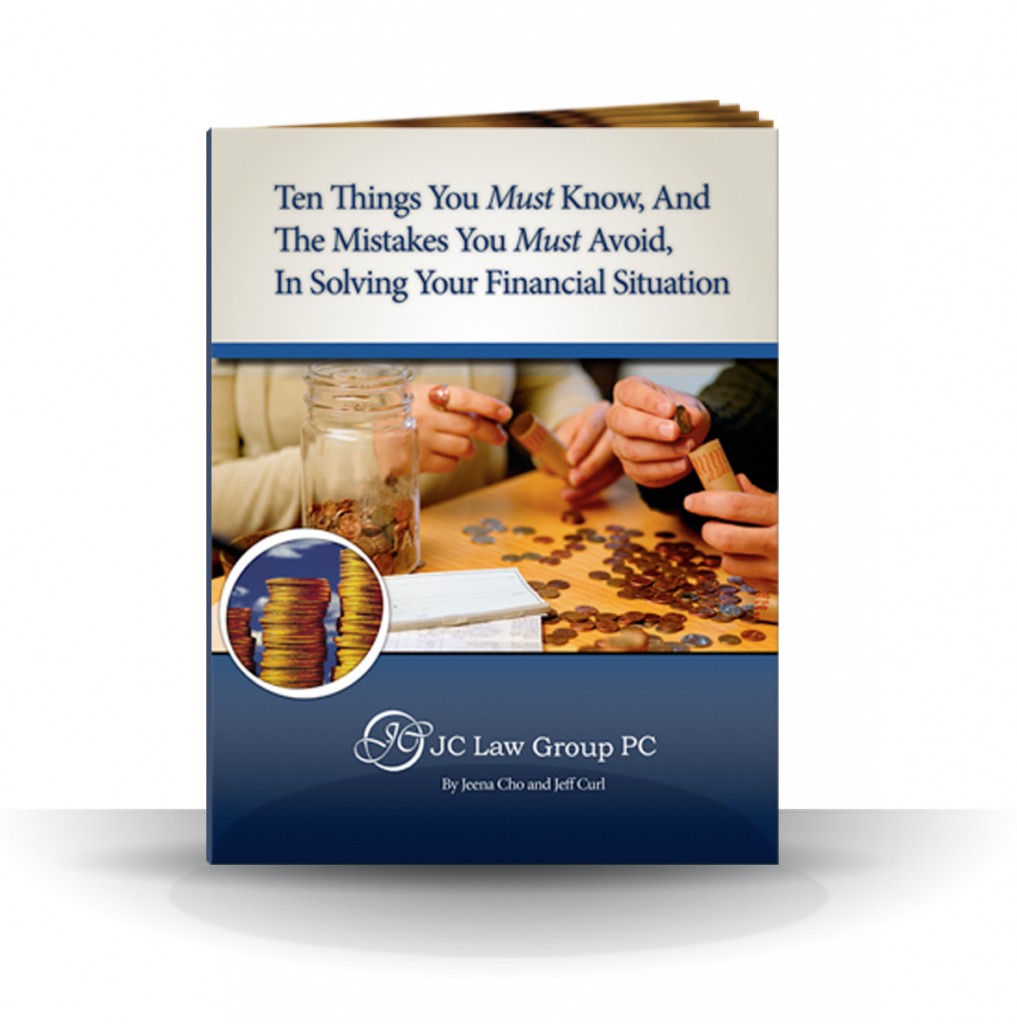
Ten Things You Must Know, And The Mistakes You Must Avoid, In Solving Your Financial Situation

By: Jeena Cho & Jeff Curl

Are you contemplating bankruptcy? Do you have questions? Download our free guide.

Topics Covered:

1. You are not alone.
2. Consequence of inaction (what if I do nothing?)
3. You may qualify for Chapter 7
4. Can you keep your property in Chapter 7?
5. Chapter 13 vs. debt consolidation
6. Who will find out about your bankruptcy?
7. Can I afford bankruptcy?
8. Truth about credit counseling
9. Getting new credit after bankruptcy
10. What’s your “exit strategy?”

Click to download.

Google+

Can I settle with my credit card?

By: Jeena Cho

Can I settle my credit card debt?

The short answer is “yes” if you have the money to settle. A typical conversation with my client goes like this.

Client: Can I settle my debt?
Me: Yes. How much do you have in your bank account?
Client: Well, not much.
Me: You need money to settle.

The general rule is you need to have lump sum cash before credit cards will settle with you. No money = No settlement. Creditors aren’t going to be particularly open to the idea of a payment plan - let’s face it, why would they give you a second chance at a payment plan when you haven’t held up your end of the bargain to begin with? So, the real question is, how much can you possibly save up to come up with in lump sum cash? And can you do so before Chase, AMEX, Discover, etc. decides to sue you?

In general, you can expect to settle your debt between 30 - 60% of the total amount owed (plus taxes to the IRS). The older the debt, the less you can settle it for. Typically, you’ll get a better deal from a debt collection company (that bought the debt for a fraction of the amount you owe) than the original creditor.

Debt settlement is best if 1) you only have a few creditor to settle with and 2) you actually have lump sum cash to settle.

Disclaimer: Unfortunately, it is impossible to give legal advice over the internet, no matter how well researched or written. Before relying on any information I give, contact a lawyer to discuss your particular situation. I am a San Francisco bankruptcy attorney. The information given is based on California law.

Google+

Financial Problems Overwhelming? - Free Workshop

Financial Problems Overwhelming?

Feeling Crushed By Debt?
Don’t Know Where To Turn?
You’re hardly alone.

Let’s face it, this recession has been brutal.

People have lost jobs, businesses have gone under, hiring is at a standstill. And if you’ve had the bad luck to suffer one of life’s misfortunes — a divorce, a medical crisis, a family emergency, loss of employment — it’s easy for your normal amount of debt to skyrocket into something unthinkable.

Are you so deeply in debt that you are:

* Borrowing money from friends and family?
* Selling off belongings or liquidating retirement funds?
* Afraid to answer the phone or open the mail?
* Experiencing terrible stress?
* Facing foreclosure?

These are questions that you may have been afraid to ask because of shame, or desperation, or because you fear being taken advantage of. You are not alone! Bankruptcy filings increased 35 percent in March 2010 — 6,900 per day! At the FREE seminar “Cover Your Assets” at the San Francisco Law Library, you will learn:

* How you can keep your house, retirement funds, and other assets
* The truth about credit ratings, debt, and bankruptcy
* Why the worst thing you can do is nothing

No one will ask your name or circumstances, and you will have a chance to ask whatever questions you may have. See the Consumer Library Workshop Flyer for full details. Register today by calling 415-963-4462 or please fill out the registration form. Space is limited.

Maybe it’s time you breakup with your bank

Written by San Francisco Bankruptcy Lawyer, Jeena Cho


As a bankruptcy attorney, I have a similar reaction when my clients will tell me that he or she really “likes” Bank of America (Chase, Wells Fargo, etc.) and don’t want to end the relationship. “I’ve been with them for years and they’ve been good to me.” Maybe your bank isn’t breaking limbs, but they can certainly be abusive. They abuse you by charging you 30% interest rate, taking your last dime, and would not hesitate to take the clothing off your back given a chance. Like the abusers in domestic violence court, they will continue to abuse until the Justice System steps in and says “ENOUGH!”When I was a prosecutor, I was assigned to the Domestic Violence court. One of the most frustrating and difficult part of my job was getting the victims of domestic violence to see that the abuser was abusive. I would have victims with black eyes, broken arms, or bruised lips look me straight in the eyes and say “Oh, but he’s been so good to me. I don’t want to end the relationship.” I’d think to myself what? Are you kidding?

That’s precisely what happened when FTC and USTP recouped $108 million from Countrywide (acquired by Bank of America) for its borrowers. Among other offensive behavior, Countryside was accused of the following:

“When homeowners fell behind on their mortgage payments, Countrywide ordered property inspections, maintenance, and other services meant to protect the lender’s interest in the property, the FTA asserted. Bur rather than simply hire vendors to perform the services, Countrywide created subsidiaries to hire the vendors. The subsidiaries marked up the price of the services charged by the vendors - often by 100 percent or more - and Countryside then charged the homeowners the marked-up fees… As these troubled homeowners found their way into bankruptcy, Countrywide continued to add on the fees …” Source: Consumer Bankruptcy News, July 1, 2010 issue.

Seriously?

If you have been in an abusive relationship with your bank, maybe it’s time you stand up for yourself and say ENOUGH! Maybe it’s time you stop giving away your hard earned dollars, or your savings over to the abuser. Unfortunately, in this abusive relationship, the abuser can refuse to let you out of the relationship. It can sue you, take your home, put liens on your property, garnish your wages and take your money.

This is why bankruptcy laws exist. It’s a legal way for victims to say to the abuser - Dear Bank, I am breaking up with you.


Google+

Need help but afraid to ask?

By: Jeena Cho

As a society, there are two things we don’t talk about. Death & Debt. Frequently, when people are experiencing financial distress, they go into denial mode. Instead of assessing their situation and tacking the problem, they deny thinking something will change. Of course, debt problems do not get better without proactive action. It gets worse. Interest rates continue to rise, you borrow from Peter to pay Paul.

If you are experiencing financial trouble, you should seek help. Go see a financial advisor, reach out and ask a friend or a family member. You will soon find that you are not alone in your problems.

For those of you that do not see any hope of being able to reduce your debt, we are offering a free seminar. If you do not want to attend in person, you can attend on the Web. It’s totally confidential. We’ll discuss the different options to deal with your debt including debt settlement and bankruptcy.

Our goal is to educate you with the options available. One of the most frequent comment I get at the end of a consultation is “I feel so much better” or “I should have come in a long time ago.” We hope to do the same through these workshops.

For more information or to register, go to http://www.jclawgroup.com/workshop/

Google+